Recognising and Preventing Hidden Stress in Dementia and Elderly Care
Discover how subtle forms of stress or “gentle violence” affect older adults in care — and learn practical ways to create calm, respectful environments.
VEILLE SOCIALERSE
LYDIE GOYENETCHE
12/11/202511 min read

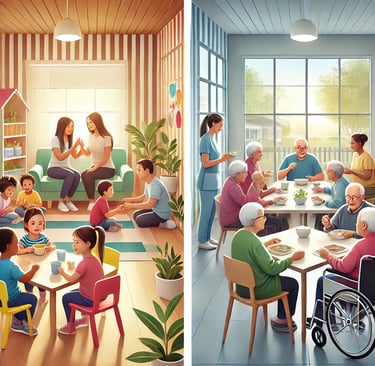
The ageing of the global population is reshaping societies at every level — medical, economic, and human. According to the United Nations World Population Prospects 2024, the number of people aged 65 and over has more than doubled since 1990, reaching over 770 million in 2023. By 2050, this figure is expected to surpass 1.5 billion, meaning that one in six people on the planet will be over 65.
Among this rapidly growing demographic, an increasing proportion live with cognitive decline or dementia. The World Health Organization estimates that 55 million people worldwide currently suffer from dementia, a number projected to rise to 139 million by 2050. In countries such as the United States, the United Kingdom, Canada and Australia, dementia is now one of the top ten causes of death, and one of the leading factors for long-term institutionalisation. In the European Union, approximately one in four residents of nursing homes is affected by a cognitive disorder.
Yet while the number of dependent elderly people rises steadily, staffing levels in care homes and senior residences remain constrained by tight budgets and rigid administrative frameworks. Facilities are required to comply with national health authorities — such as the Care Quality Commission (CQC) in the UK or state-level agencies in the US — which set ratios and procedural standards to ensure safety and traceability. These frameworks, though essential, often result in highly standardised routines where time is segmented and human interaction becomes secondary to compliance.
As a result, professionals find themselves under constant time pressure: a limited number of caregivers must provide assistance for meals, hygiene, medication, and emotional support to dozens of residents. In such environments, invisible forms of stress and “gentle violence” can emerge — not from cruelty or neglect, but from repetition, fatigue, and systemic constraints. The term gentle violence refers to subtle, unintentional behaviours that can nonetheless create discomfort, confusion, or emotional pain: a hurried meal, a loud tone of voice, a caregiver speaking about a resident in the third person, or a touch devoid of presence.
Studies in geriatric psychology show that up to 40 % of nursing home residents experience symptoms of anxiety or agitation linked not to disease progression but to environmental factors such as noise, overstimulation, or lack of meaningful interaction. In dementia care units, non-verbal communication accounts for over 70 % of perceived emotional safety, making posture, tone, and facial expression as critical as medical care itself.
This reality raises a pressing ethical and practical question shared across the English-speaking world: how can caregivers maintain respect, calm, and dignity when institutional structures leave so little time for genuine presence? Recognising and preventing hidden stress requires more than additional protocols; it calls for a shift in perception — from managing bodies to accompanying persons.
This article explores how subtle forms of violence emerge in ordinary caregiving contexts, how they are perceived through cognitive and sensory profiles, and how small adjustments — in environment, rhythm, and non-verbal behaviour — can profoundly reduce anxiety and restore a sense of peace and humanity within care settings.
Understanding “Gentle Violence”: Between Perception, Cognition and Reality
Defining Dementia and Cognitive Decline
Dementia is not a single disease but a syndrome of progressive cognitive decline caused by various neurodegenerative conditions such as Alzheimer’s disease, Lewy body dementia, frontotemporal dementia, or advanced Parkinson’s disease.
According to the World Health Organization (2023), Alzheimer’s disease accounts for 60–70% of all dementia cases worldwide. Dementia primarily affects the hippocampus and entorhinal cortex, which are crucial for memory and spatial orientation, as well as the prefrontal cortex, which governs planning, reasoning, and emotional regulation.
The parietal lobes, responsible for spatial and sensory integration, are also frequently impaired. However, regions such as the amygdala and limbic system, which process emotional and non-verbal communication, often remain active well into the later stages of the disease.
This means that while logical reasoning and verbal comprehension decline, the emotional and sensory systems remain vivid. The person may no longer understand the meaning of words, but they feel tone, rhythm, movement, and the emotional atmosphere of a room with extraordinary intensity.
When Decision-Making Is Taken Away
In care institutions — nursing homes, assisted living residences, or memory units — older adults face a profound loss of autonomy. Their daily lives are structured by external routines: fixed meal times, imposed hygiene schedules, collective activities, and limited opportunities for personal choice.
For a healthy brain, these are logistical details. For a brain affected by dementia, they represent a cognitive and emotional overload. The prefrontal cortex, which manages flexibility, inhibition, and adaptation, is one of the first regions to deteriorate in neurodegenerative diseases.
As a result, any imposed change — a loud room, a rushed meal, or an unexpected touch — can trigger anxiety or confusion. The person is unable to contextualize what is happening, yet their emotional brain still registers threat and loss of control.
Overstimulation: When the Environment Becomes Hostile
Collective living environments, though designed for safety and efficiency, often become sources of sensory aggression.
Research published in The Lancet Neurology (2020) found that 45% of residents with advanced cognitive impairment show agitation behaviours directly linked to overstimulation — excessive noise, crowded dining halls, bright lighting, and continuous movement of staff.
A study by the University of Toronto (2021) demonstrated that reducing ambient noise by just 20 decibels in a dementia unit decreased agitation episodes by 35%. Similarly, the introduction of calm zones with stable lighting and reduced visual clutter improved orientation and emotional stability.
Yet many care facilities, constrained by staff shortages and budgetary limits, rely on rigid, collective organization. Meals are served to dozens at once; hygiene care is timed; professionals must complete each act quickly. The pressure of routine transforms gestures of care into automatized actions, where the emotional dimension is often sacrificed for efficiency.
The Emotional Brain Still Speaks
What caregivers experience as “neutral” or “routine” can be perceived by a person with dementia as intrusive or threatening. Because the amygdala, the brain’s emotional alarm center, remains active long after cognitive decline has set in, the body continues to respond to non-verbal signals: a loud voice, a sudden movement, a lack of eye contact.
When the caregiver’s tone is impatient, the resident’s amygdala may interpret this as danger, activating physiological stress responses — elevated heart rate, muscle tension, or withdrawal. These reactions are not behavioural “symptoms” of dementia but emotional defence mechanisms.
In this sense, gentle violence arises when the intentions of the caregiver and the perceptions of the resident diverge. It is not rooted in malice but in misunderstanding. The professional acts efficiently; the resident experiences confusion or fear. This silent friction is where ethical tension begins.
A Neuropsychological Perspective on “Gentle Violence”
Understanding gentle violence through a neuropsychological lens reveals that environmental and relational factors can exacerbate cognitive disorders. In overstimulating settings, the brain’s sensory and emotional circuits are overactivated, while its adaptive and regulatory regions are underfunctioning.
This imbalance leads to chronic stress responses, which in turn accelerate cognitive decline — a cycle documented by the National Institute on Aging (NIA, 2022) and the Alzheimer’s Association (2023). Emotional overstimulation increases cortisol production, damages hippocampal neurons, and undermines short-term memory and orientation.
Recognizing these dynamics is essential. It shifts the focus from “managing symptoms” to addressing causes: the environment, the rhythm, and the quality of human presence.
Beyond Ethics: Restoring Humanity in Care
Gentle violence is not only an ethical issue; it is a neuropsychological reality. The brain affected by dementia remains profoundly responsive to tone, rhythm, gaze, and touch. A hurried or absent gesture, though efficient, can register as rejection; a calm voice or gentle pause can restore a sense of safety.
In institutional settings driven by protocols and performance indicators, reclaiming slowness and presence is not inefficiency — it is therapy. Recognising gentle violence means learning to read beyond words, to perceive with empathy what the other’s nervous system endures in silence.
True respectful care begins not with more procedures, but with a shift in consciousness: understanding that every act of care is a dialogue between two nervous systems, and that peace — not speed — is the measure of success.
In many long-term care facilities — whether in France, the United Kingdom or North America — spaces already exist for this kind of slow, attentive presence: quiet rooms, therapeutic gardens, and sometimes even a weekly religious service. These moments do not enforce belief; they offer rhythm, meaning, and emotional safety. They remind us that older adults are not defined by cognitive loss alone but also by their symbolic, relational and spiritual depth. This connection between presence, inner life and dignity echoes the broader reflection explored in [my spiritual article], where the emotional and symbolic dimensions of care become essential anchors for peace.
The Role of Non-Verbal Communication: A Universal but Unevenly Recognized Language
Early Childhood and Old Age: Two Vulnerabilities, One Emotional Language
In both early childhood and advanced age, the prefrontal cortex — the region responsible for reasoning, impulse control, and executive planning — is either not yet developed or progressively impaired.
Before the age of three, the child’s brain operates primarily through the limbic system, which governs emotions, attachment, and sensory perception. The prefrontal cortex begins to mature around age four but does not reach full functional connectivity until the mid-twenties (Harvard Medical School, Brain Development Study, 2020).
Conversely, in older adults, especially those living with dementia, this same area undergoes atrophy of approximately 5–8% per decade after age 50 (The Gerontologist, 2021). The deterioration of executive functions — attention, inhibition, and planning — mirrors the immaturity of these same functions in very young children. In both groups, non-verbal signals such as tone, posture, rhythm, and emotional atmosphere become the dominant channels of understanding.
However, the trajectories differ profoundly. The child’s brain is under construction, shaped by plasticity and discovery; the older adult’s brain is in deconstruction, navigating loss and adaptation. Yet both depend on the same fundamental conditions for stability: predictability, gentle rhythm, and emotional safety.
Why Early Childhood Practices Evolve Faster
Since the early 2000s, early childhood education has undergone a quiet revolution guided by affective neuroscience. Studies by Catherine Gueguen, Daniel Siegel, and Boris Cyrulnik have shown that empathy and co-regulation are biologically necessary for healthy neural development.
In France, the National Family and Childhood Council (HCFEA) now integrates these principles into its professional standards, while in the United States, programs such as Head Start and Zero to Three encourage similar emotionally intelligent caregiving approaches.
Quantitatively, these reforms have measurable outcomes:
Reducing classroom or daycare noise levels by 10 decibels lowers stress-related crying by 40% among children under three (INSERM, 2019).
Facilities that introduce quiet corners and soft lighting report 25% fewer behavioural incidents and 30% higher social engagement (OECD Early Childhood Study, 2022).
This shift toward emotional literacy and non-violent communication is grounded in neuroscience and widely disseminated in professional training.
By contrast, the geriatric sector has evolved far more slowly. Most training programs for nursing assistants or caregivers still prioritize safety, hygiene, and administrative compliance over emotional interaction. In long-term care facilities, where one caregiver may be responsible for 10 to 15 residents per shift (OECD Health Data, 2023), emotional attunement is often sacrificed to efficiency. The absence of structured training in non-verbal caregiving perpetuates automatic routines that unintentionally generate stress and disconnection.
Two Ways of Seeing Cognitive Impairment
This disparity between early childhood and geriatric care is not only institutional but symbolic.
In children, cognitive or developmental challenges are perceived as a stage to be nurtured — a process of becoming.
In older adults, cognitive impairment is viewed as a decline to be managed, an irreversible loss of personhood.
These differing perceptions shape professional posture. In nurseries and preschools, practitioners are trained to co-construct meaning with the child, verbalize emotions, and adapt to their sensory pace. In nursing homes, the focus often shifts to decision-making by substitution — professionals decide for, rather than with, residents.
Yet neuroscience tells us that the emotional need for coherence and safety does not diminish with age. The amygdala and limbic system — responsible for emotion and threat detection — remain functional long after language and memory fade.
A study from the University of Geneva (2021) found that elderly residents exposed to calm voices and direct eye contact showed a 28% reduction in anxiety episodes, independent of medication.
Where a toddler learns to trust the world, the person with dementia learns to trust it again. In both cases, trust depends on emotional congruence between what is said and what is felt.
Neurodivergence and Fragility of “Cold” Cognitive Functions
Between these two ends of life lies another group: neurodivergent adults, whose cognitive profiles sometimes echo those of young children or older adults with dementia.
Research on ADHD, autism spectrum disorder, and executive dysfunctions shows reduced performance in “cold” cognitive functions (planning, inhibition, sequencing), combined with heightened activation of “hot” emotional networks (intuition, empathy, reactivity).
Studies by Jean Decety (University of Chicago) and Boris Cyrulnik (2022) confirm that individuals with atypical cognition exhibit greater sensitivity to tone, body language, and emotional atmosphere — precisely the elements that are misunderstood or neglected in geriatric institutions.
This parallel underscores a universal truth: whether due to immaturity, neurodivergence, or degeneration, the fragility of the prefrontal cortex demands environmental adaptation, not control.
Toward an Ethics of Emotional Reciprocity
The recognition of non-verbal communication has reshaped early childhood education: less authority, more presence, more attunement. In geriatric care, however, the prevailing logic remains hierarchical and procedural — oriented toward risk management rather than relational harmony.
Yet the neuropsychological foundations are identical. The brain that is not yet mature and the brain that is disintegrating both react with stress to noise, abrupt gestures, and emotional incoherence.
Anxiety, agitation, or withdrawal are not symptoms to suppress but signals of unmet sensory and relational needs.
Re-establishing parity between these stages of life requires a new ethics of reciprocity. The young child and the elderly adult are not passive recipients of care but partners in an emotional dialogue.
The language of care is not primarily verbal; it is gestural, rhythmic, and affective — the same language that builds trust at the beginning of life and preserves dignity at its end.
Conclusion: Recognising and Preventing Hidden Stress in Caregiving
Hidden or “gentle” violence in caregiving does not arise from ill will, but from the tension between institutional constraints and human vulnerability. It manifests silently — in the tone of a rushed voice, in a lack of gaze, in routines that prioritise efficiency over presence. For the person living with dementia, whose prefrontal cortex is impaired but whose emotional brain remains fully alive, these micro-gestures are experienced not as neutral, but as deeply unsettling.
The first step toward prevention is recognition — understanding that subtle violence is not about physical harm, but about emotional dissonance. When the body language, tone, or rhythm of the caregiver contradicts the message of care, the resident’s nervous system reacts with stress. This reaction is not behavioural “agitation”; it is a physiological alarm. Neuroimaging studies (NIH, 2022; The Lancet Neurology, 2020) show that such stress increases cortisol levels, disrupts circadian regulation, and accelerates hippocampal atrophy — all of which intensify confusion and dependency.
To prevent this cycle, caregiving must evolve from a task-based model to a sensory-relational model. The most effective interventions identified in current research share three dimensions:
Environmental Design – Reducing overstimulation through acoustic comfort, natural light, and spatial coherence. Studies from the University of Toronto and King’s College London report up to 35% fewer agitation episodes in dementia units with structured calm zones and reduced ambient noise.
Non-Verbal Training – Teaching caregivers to use posture, tone, and gaze intentionally. Programs incorporating video feedback and mindfulness-based communication show a 25–40% decrease in stress indicators among residents and staff alike (Journal of Alzheimer’s Disease, 2021).
Organisational Flexibility – Allowing autonomy in small, person-centred routines. When residents can choose when to eat, rest, or engage in activity, levels of behavioural distress fall by nearly half (OECD Long-Term Care Report, 2022).
At the heart of these strategies lies a change in ethical perspective: to shift from doing for to being with. Just as early childhood education has embraced neuroscience to create emotionally secure environments, geriatric care must integrate similar insights — not as a luxury, but as a necessity for dignity and health.
Recognising gentle violence means acknowledging that care is communication. Every movement, every silence, every micro-decision carries emotional weight. To prevent hidden stress, professionals must become fluent in this silent language — attuning not only to what they do, but to what the other perceives and feels.
In the end, respectful caregiving is not about perfection but presence: slowing down enough for empathy to be perceived. When we align gesture, tone, and intention, the hidden violence of care dissolves — and what remains is the quiet humanity that connects all ages, from the child discovering the world to the elder learning to let it go.
For facilities wishing to improve communication without compromising dignity or regulatory compliance, a strategic approach is essential. Ethical visibility is not about showcasing residents; it is about expressing a philosophy of care, creating clarity for families, and ensuring that the organisation’s values are genuinely understood. This is the purpose of my [SEO & communication service], which helps long-term care providers strengthen their online presence through ethical content, accessible language, and compliance-friendly visibility strategies tailored to sensitive sectors.
EUSKAL CONSEIL
9 rue Iguzki alde
64310 ST PEE SUR NIVELLE
07 82 50 57 66
euskalconseil@gmail.com
Mentions légales: Métiers du Conseil Hiscox HSXIN320063010
CGV & Mentions légales
Ce site utilise uniquement Plausible Analytics, un outil de mesure d’audience respectueux de la vie privée. Aucune donnée personnelle n’est collectée, aucun cookie n’est utilisé.