Marketing & CSR Strategy for Nursing Homes: Rebuilding Trust and Creating Human-Centered Care
Find out how to develop a marketing & CSR strategy for nursing homes. Concrete solutions, examples in France and Europe, and advice to meet the expectations of residents, families and caregivers.
VEILLE SOCIALEVEILLE ECONOMIQUEMANAGEMENTRSEMARKETING
Lydie GOYENETCHE
10/28/20257 min read
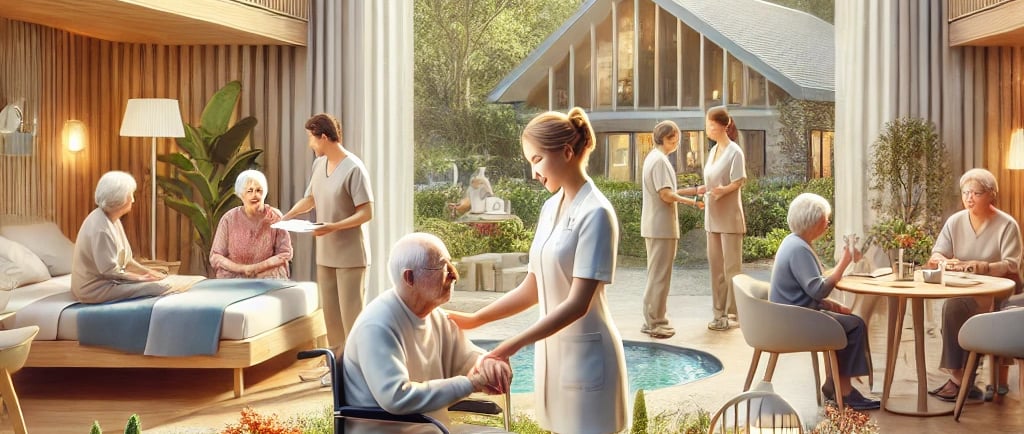
The sector of residential care for older adults is undergoing profound change. With rising expectations from residents, increasing demands from families, and intensive pressure on staffing and operating models, nursing homes must adopt more than just care-focused approaches. They must embrace marketing strategies rooted in robust CSR (Corporate Social Responsibility) practices.
Globally, particularly in English-speaking countries, the model is largely driven by market mechanics. For example in the United States, the nursing home industry comprises more than 15,000 facilities, covering over 1.6 million beds, and generates upwards of US$160 billion annually. In that context, it’s essential to differentiate through brand positioning, quality of experience, and stakeholder trust. Conversely, in Europe, and notably in France, the model leans more toward social responsibility, regulation and trust-based relationships. French EHPADs (Établissements d’Hébergement pour Personnes Âgées Dépendantes) must deliver high standards of care, transparent governance, and measurable social impact.
These divergent paradigms create a crucial question for any nursing home operating internationally: How can you enhance attractiveness and diversification without resorting to superficial marketing? How can you modernise image, reassure families, attract talent, and remain relevant — while embedding CSR in your strategy?
The answer lies in the intersection of marketing and CSR. Marketing provides visibility; CSR provides credibility. A facility that showcases its community impact, social responsibility, and resident-centred innovation will stand out in a crowded field. To succeed, nursing homes must:
Illuminate real initiatives that benefit residents, families and staff.
Adopt digital tools to show day-to-day life within the facility.
Embed professional ethics that are visible, measurable and authentic.
Respond to the emerging generation of seniors who are more connected, more demanding and more independent.
Transparency & Ethical Practices: Rebuilding a Weakened Reputation (CSR Pillar: Governance)
The nursing home sector has suffered notable reputational damage, notably in France with the Orpea affair, which exposed serious failings in care and oversight. In a context where trust is fragile, adopting transparent governance and proactive communication is essential.
Examples of success include LNA Santé in France, which publishes quality indicators and family satisfaction reports; and Swedish nursing homes leveraging real-time digital platforms to let families monitor activity and care of their loved ones. These practices embody CSR in action: responsible governance, open communication, accountability.
From the marketing perspective, a transparent facility is a trustworthy brand. That trust translates into higher occupancy, better family referrals, and stronger loyalty.
Family Engagement: Restoring Essential Human Bonds (CSR Pillar: Social Impact)
During the COVID-19 pandemic, many nursing homes went into lockdown with restricted family visits. The damage has been high in terms of emotional cost, resident isolation and family frustration. The post-pandemic era demands more than reopening doors: it requires rebuilding relationships.
Innovations that work include the Colisée group in France, which developed dedicated safe-visit spaces even during health-restriction periods; and Italian “cuddle rooms” allowing physical contact through flexible protective curtains. These initiatives show that despite constraints, connection remains vital.
From a marketing standpoint, emphasising family-centre engagement strengthens word-of-mouth, increases comfort in decision making and positions the facility as one that cares beyond just the clinical.
Personal Autonomy & Life Quality: Putting the Person at the Center (CSR Pillar: Human Dignity)
Entering a nursing home often means adapting to a collective rhythm which can threaten personal identity and autonomy. This is an opportunity: institutions that enable personalised autonomy will create a meaningful competitive advantage.
For example: the Partage & Vie foundation in France organises weekly outings for shopping or cultural visits; Germany’s “Seniorenbus” initiative grants residents independent travel options for their personal activities. These show that collective living and personal freedom can coexist.
In terms of marketing, emphasising programmes that restore autonomy signals “premium living” in senior care — an attractive proposition for both residents and families.
New Seniors, New Expectations (CSR Pillar: Quality of Life & Well-Being)
The new generation of seniors — often referred to as the “Baby-Boomer wave” — is transforming the future of elderly care. Better educated, more connected and with higher life expectancy, they are no longer looking for a place to simply “grow old,” but for a living environment that supports their identity, their social role, and their aspirations. More than 70% of seniors in Europe say they want a retirement that includes cultural activities, autonomy and continued engagement in meaningful routines.
However, the level of dependence significantly affects how these expectations can be met. In protected units or Alzheimer’s care units, for example, preserving autonomy and dignity becomes an everyday ethical challenge. Clothing is sometimes kept locked away to avoid confusion or unsafe dressing choices; residents may have to wait for a caregiver to assist with hygiene and select their outfit. For residents experiencing cognitive or behavioural disorders — such as nighttime disorientation or a tendency to remove protective garments — staff may resort to wearing secure jumpsuits (grenouillères) to prevent skin damage or infection.
These decisions are never trivial. They touch the most intimate aspects of a person’s identity — their body, their privacy, their ability to choose. Each day, care teams must navigate a delicate balance between freedom and safety, asking themselves:
How can we protect without infantilizing?
How can we comfort without restraining?
How can we preserve dignity when protection becomes necessary?
This is the true CSR challenge of elderly care: respecting the person even when their illness steals parts of who they are. It requires ethical reflection, teamwork, individualized assessment and ongoing dialogue with families — who also carry emotional expectations and vulnerabilities.
From a marketing perspective, acknowledging this reality is not a weakness but a strength. Facilities that communicate honestly about the complexity of care — and demonstrate how they support staff in ethical decision-making — differentiate themselves with authenticity and trust.
Digital Presence & Visibility: Trust Before Arrival (CSR Pillar: Transparency & Equal Access)
In the digital era, families rarely choose a care facility without researching it online. A strong digital presence builds trust long before the first physical visit: virtual tours, authentic storytelling on social media, and transparent review management shorten decision cycles and help families feel reassured.
However, the digital reality inside the facility is often far more complex. While many residents in France have a television in their room, only a minority have a personal internet connection or computer. A large proportion struggle with digital tools, especially when working memory and learning abilities decline. Expecting them to maintain social connections through digital means can become frustrating rather than empowering.
Caregivers, already managing demanding workloads — sometimes over 20 rooms per floor — cannot realistically provide daily digital support for each resident. Digital access can therefore become a privilege of autonomy, not a universal right.
Additionally, many services marketed as “enhancing connection” are paid add-ons. Yet a significant portion of residents can only afford the basic package of nursing home services. When digital inclusion depends on the resident’s budget, inequality risks becoming embedded in the care model.
This represents a core CSR challenge for the sector:
How can we ensure that digital transformation enhances dignity rather than widens the gap between residents?
Staff Attraction & Retention: The Social Responsibility Imperative (CSR Pillar: Workforce)
In many nursing homes, staff turnover is not annual or even quarterly—it can be monthly or even daily. Low wages, rigid schedules, a highly task-oriented work rhythm, intense emotional labour, insufficient staffing, and the physical and relational demands of residents all combine to make long-term retention extremely difficult. When staff change constantly, a resident—already often entering the facility in a situation of loss or transition—faces not only the disruption of ties with family or former social networks, but also the inability to develop consistent, trusting relationships with the caregivers. This double rupture undermines the institutional capacity to provide what psychoanalytic and developmental theory call a “holding environment” (cf. Donald Winnicott) or a secure attachment framework (cf. John Bowlby) which is foundational for dignity and well-being in care settings.
Empirical research supports this: the Job Demands‑Resources Model (JD-R) demonstrates that job demands such as time pressure, emotional intensity and workload, when not balanced by sufficient job resources (autonomy, supervisor support, career growth) lead to burnout and turnover intention among healthcare professionals. For example, one integrative review identifies work overload, lack of formal rewards and work–life interference as key “job demands” for nursing staff, while supervisor support, authentic management, interpersonal relations and autonomy are critical “job resources”. A recent study found that transformational leadership and work–life balance significantly predicted nurse retention (β = 0.171 for transformational leadership; β = 0.426 for work–life balance) in a hospital context.
For nursing homes, the message is clear: without stabilised teams, the promise of care continuity, relational attachment and organisational credibility collapses. From a CSR perspective, the workforce is not just a cost item—it is a relational asset. Recognising the inherent vulnerability of residents (especially in Alzheimer’s or protected units) means acknowledging that each change of caregiver is potentially a micro-trauma: the loss of “the familiar face”, the interruption of shared history, the renewal of uncertainty.
From a marketing standpoint, a strong employer brand is therefore no longer optional: it is an integral part of the resident brand. Families perceive that if staff rotate endlessly, then “who will care for my parent?” becomes a real question. Conversely, when a facility can show low turnover, stable teams, mentorship programmes, transparent career paths and meaningful support for staff, it builds trust, reinforces its reputation, and differentiates on service quality. That is CSR made visible: investing in staff wellbeing, continuity and ethical labour translates directly into resident-care quality, organisational legitimacy and market positioning.
Conclusion
Caring for older adults goes far beyond delivering medical and functional support. It involves preserving identity, nurturing belonging and sustaining dignity when vulnerability increases. Marketing can highlight these values, but only a genuine commitment to social responsibility makes them credible and lasting. After years of scandals and distrust, the true challenge for nursing homes is not to present an idealized image but to demonstrate, day after day, that each resident remains a person whose life continues to hold meaning. Transparent practices, a sincere engagement with families, and everyday attention to emotional safety are necessary to rebuild what has been damaged.
The continuity of human presence is at the heart of this transformation. No innovation, no technology and no system can compensate for the absence of stable, caring relationships. When staff turnover breaks attachments, when working constraints erode autonomy and when promises exceed what can be realistically delivered, the institution risks failing in its most fundamental responsibility: providing a secure world to those who can no longer build that world for themselves. And yet, precisely here lies the horizon of renewal. Nursing homes that choose to integrate CSR not as a marketing argument but as a daily ethic of care can open the path to trust again and reassert their social mission.
A nursing home is not meant to be a place where life stops. It can be a place where life continues differently, with new forms of presence, attention and shared human experience. Marketing gives visibility to this ambition. CSR gives it depth, substance and truth. Together, they enable each resident to feel that they remain someone who counts, someone who matters, someone expected and accompanied. For residents who arrive in a situation of rupture, for families who need reassurance, and for caregivers who deserve recognition and support, this alignment between communication and responsibility is what gives meaning to the work and coherence to the institution’s purpose.
Caring is a value. Making it visible is a responsibility. Ensuring it remains true is a commitment that must guide every decision. In this alignment between what is shown and what is done lies the future of nursing homes, and the possibility of rebuilding a model that honors our elders with respect, humanity and confidence.
This article is part of a broader reflection on dignity, time and engagement in long-term care settings. I support organisations in translating scientific and ethical insights into clear, responsible CSR and institutional content, adapted to highly regulated environments.
EUSKAL CONSEIL
9 rue Iguzki alde
64310 ST PEE SUR NIVELLE
07 82 50 57 66
euskalconseil@gmail.com
Mentions légales: Métiers du Conseil Hiscox HSXIN320063010
CGV & Mentions légales
Ce site utilise uniquement Plausible Analytics, un outil de mesure d’audience respectueux de la vie privée. Aucune donnée personnelle n’est collectée, aucun cookie n’est utilisé.