Nonverbal Communication: A Hidden Lever for Social Performance and Inclusion in the Workplace
Discover how Nonverbal Communication can strengthen team cohesion, foster inclusion, and enhance well-being at work. A powerful tool for HR leaders and companies committed to Corporate Social Responsibility (CSR).
VEILLE SOCIALEMANAGEMENT
LYDIE GOYENETCHE
6/19/20268 min read
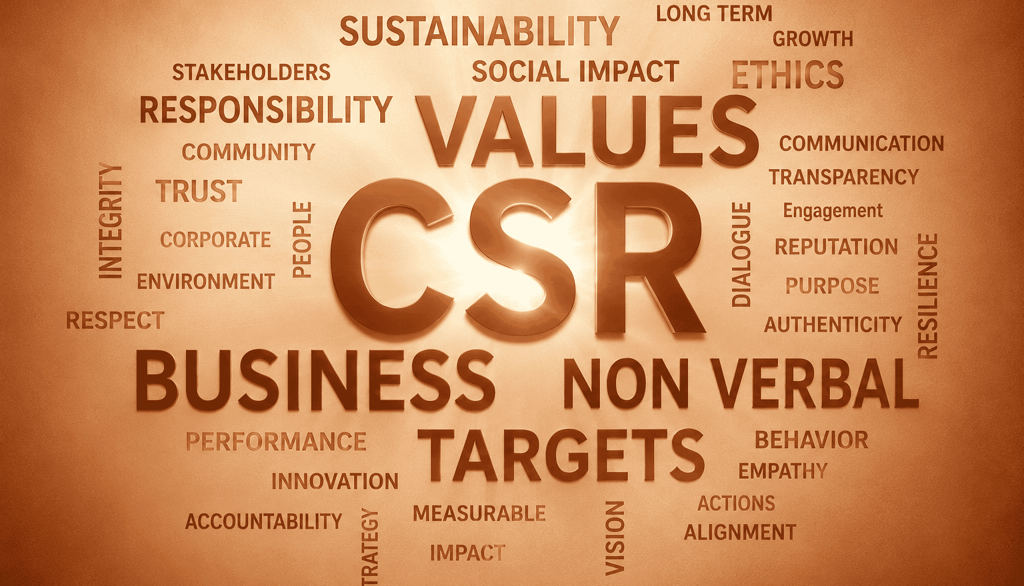
CSR: Values in Action
Corporate Social Responsibility is a delicate balance of idealism and pragmatism. On one side lies a vision—a commitment to a better world by integrating social and environmental concerns. On the other, the practical demands of business: performance, growth, and competitiveness. CSR strives to bridge these two realms.
Take a simple example: a company that reduces its environmental footprint by adopting cleaner processes, while simultaneously lowering production costs through more efficient resource management. In doing so, it satisfies stakeholders—customers, employees, investors—while boosting financial performance. All of this is embedded within a sustainable management framework, where daily decisions are guided by a long-term vision.
But it doesn’t end there. When genuinely embraced, CSR evolves into a true business philosophy. It influences strategic decisions, shapes employer branding, and initiates a virtuous cycle in which responsibility and performance reinforce each other.
The Evolution of CSR: A Response to Social Expectations
CSR has deep historical roots. In the 1970s, as environmental issues gained global attention, some companies began rethinking their role in society. But it wasn’t until the 2000s that CSR became a pressing imperative, driven by increasingly demanding consumers and tightening regulations.
Today, CSR is no longer a choice—it’s a standard. Companies that aim to remain competitive must engage meaningfully, whether by reducing their environmental impact, improving working conditions, or investing in local communities. They’ve come to understand that their image, resilience, and long-term success depend on it.
CSR and Corporate Culture: A Powerful Partnership
CSR’s impact goes far beyond environmental or philanthropic efforts. It deeply shapes corporate culture. A well-crafted CSR policy becomes a powerful driver of trust, employee motivation, and talent attraction.
Imagine an employee who knows their company genuinely cares—for the planet and for its people. The result? They feel aligned with their employer’s values, increasing their sense of engagement and purpose.
This is where nonverbal communication becomes essential. Why? Because the gestures and attitudes of a leader often speak louder than words. An open posture, a genuine smile, a moment of attentive listening—these can express CSR values more powerfully than any internal memo or corporate newsletter.
The Role of Nonverbal Language in a CSR Strategy
CSR is not merely a matter of reports and metrics—it’s grounded in human relationships, where nonverbal communication plays a pivotal role. Whether in internal exchanges between colleagues or external interactions with partners and clients, nonverbal cues amplify the impact of a company’s responsible approach.
Consider inclusion. In a truly committed company, a warm smile or a kind look can profoundly affect a person with a disability. These small, often unnoticed gestures carry the weight of sincerity and authenticity—hallmarks of meaningful CSR.
CSR as a Catalyst for Global Strategy
Embedding CSR into a company’s broader strategy means transforming it into a true agent of change. It prompts critical questions: How can we address economic and environmental challenges more responsibly? How can we infuse human values into every interaction, whether verbal or nonverbal?
What sets genuinely committed companies apart isn’t just what they say—it’s what they do, and more importantly, what they show through their behavior. Words may fade, but actions and gestures linger in memory. For these actions and gestures to be understood beyond the immediate context, they must also be translated into clear, faithful narratives that reflect the reality of the field rather than abstract commitments.
Emotional Regulation and the Neurotypical Brain: The Hidden Language Beneath Nonverbal Expression
For most neurotypical individuals—that is, people whose brains follow the dominant patterns of cognitive and emotional functioning—emotions are naturally regulated through subtle bodily and vocal adjustments. These micro-signals often pass unnoticed: a slight tension in the voice, a shift in posture, a change in breathing rhythm, or a fleeting hand movement. They are not always a direct reflection of the emotion felt in the moment. Rather, they serve as the body’s way of rebalancing the limbic system, the part of the brain responsible for emotion, motivation, and memory.
Through social learning and repeated experiences, neurotypical brains have developed automatic emotional self-regulation mechanisms. When internal tension arises—stress, frustration, excitement, anxiety—the body instinctively releases this energy through tone, gesture, or movement. This is a form of limbic homeostasis, a kind of emotional thermostat designed to maintain internal stability. In this way, nonverbal behavior functions as an invisible process of rebalancing, not just a form of communication.
For neurodivergent individuals—especially those with ADHD and sensory hypersensitivity—these subtle cues do not go unnoticed. Their brains operate with reduced filtering in the prefrontal cortex, meaning they receive and process a constant flow of sensory and emotional information. Where a neurotypical brain automatically filters the irrelevant, an ADHD brain perceives everything: the tension in someone’s jaw, the shift in tone between two words, the micro-expression that lasts only a fraction of a second.
Neuroscientific research links this heightened perception to stronger connectivity between the limbic system and associative cortical areas, combined with lower inhibition in attentional control circuits. In other words, the ADHD brain is unable to fully “tune out” emotional stimuli. It remains permanently open to the affective and sensory dimension of the environment—a trait that can be exhausting, but also deeply insightful.
As a result, people with ADHD often perceive not just what others feel, but how their brains regulate those feelings. What most people interpret as a tone of irritation or a nervous gesture, the hypersensitive observer recognizes as a limbic adjustment, a bodily attempt to restore equilibrium.
This reveals a profound truth: nonverbal language is not only a vehicle for communication—it is a system of emotional regulation. The gestures, postures, and vocal variations of neurotypical individuals are not merely expressive—they are functional, designed to stabilize their inner state in response to the lived intensity of reality.
And, as observed since childhood, no one truly escapes this biological rule. Even those who have cultivated deep spiritual awareness or emotional mastery continue to rely, unconsciously, on these micro-regulations. Because before being psychological or spiritual, emotional regulation is biological—it is how the body sustains the brain’s equilibrium.
Nonverbal Language, ADHD, and the Power of Subtlety: A Hidden Asset for CSR and Team Cohesion
CSR is far more than an environmental pledge—it shapes how companies relate to employees, partners, and society at large. At the heart of sustainable development, CSR weaves together environmental stewardship, economic resilience, and human-centered management to create shared value. Yet behind the policies and bold declarations lies a quieter, more nuanced dimension: nonverbal communication.
This invisible realm—comprising gestures, glances, and postures—plays a fundamental role in team dynamics and the integration of diverse individuals. By exploring how “nonverbal champions,” such as individuals with ADhD or mental disabilities, transform interactions, we uncover how this form of communication can powerfully elevate CSR initiatives.
Emerging in the 1970s and gaining traction in response to social expectations, CSR has become indispensable for companies navigating the demands of modern stakeholders. Its scope today goes far beyond green practices or published impact reports. It redefines organizational culture, encouraging deeper human connections and bringing visibility to often-overlooked talents.
This transformation cannot occur without acknowledging the foundational role of nonverbal communication—a universal language that transcends words.
From our earliest days, we communicate nonverbally. A smile, a glance, a shift in tone—these express far more than words alone. According to Mehrabian’s research, nonverbal cues account for 93% of communication: 55% through facial expressions and body language, and 38% through tone of voice. Words account for a mere 7%. This ratio is even more pronounced for children, individuals with mental disabilities, or those living with ADD, for whom nonverbal expression is often the primary means of understanding the world.
People with ADHD, for instance, often exhibit remarkable sensitivity to nonverbal signals. They perceive subtle changes in tone, fleeting micro-expressions, and other nuances that most overlook. While this hypersensitivity can sometimes lead to emotional overwhelm, it also enables them to detect tension or discomfort before it escalates. To harness this potential, companies must create safe spaces for them to share their insights and offer a work rhythm that respects their cognitive style.
For individuals with mental disabilities, nonverbal communication often takes center stage as their main channel for connection. Their use of expressions, gestures, and emotional resonance allows them to form bonds that are frequently more genuine than those forged through speech. Within a team, this can be a transformative force—provided it is met with attentiveness and care from peers and managers alike.
In the context of CSR, integrating nonverbal communication into company life becomes a powerful tool for enhancing human connection. It begins with active listening—not only to words, but to body language and facial expressions, which can reveal fatigue, discomfort, or deeper concerns. A manager attuned to these signals can act early, fostering trust and defusing tensions before they arise.
Nonverbal language also plays a key role in inclusive practices. In diverse work environments, every gesture matters. A welcoming attitude or heartfelt smile can convey a sense of belonging more effectively than any written policy. These micro-actions foster a culture in which everyone feels safe to contribute at their own pace, with their unique strengths.
Team dynamics shift in response. When companies value the perceptiveness of individuals attuned to nonverbal cues—whether due to ADhD, neurodiversity, or other factors—they cultivate a richer balance. These team members, often finely attuned to subtle signals, invite their colleagues to slow down, observe, and co-create a shared rhythm. This harmony isn’t imposed—it grows from mutual attentiveness and emotional sincerity.
In the end, CSR is not merely about written commitments or isolated initiatives. It flourishes in authentic, human relationships where nonverbal expression holds center stage. People with ADD or mental disabilities remind us that true listening goes beyond speech. By recognizing and nurturing these often-undervalued strengths, companies can deepen their social impact and build more inclusive, compassionate, and cohesive work environments. Because while words may be fleeting, it is often gestures and glances that leave a lasting mark on the heart.
FAQ: Beyond Keywords – Editorial & GEO Strategy for High-Value Conversion
What is the fundamental difference between "Keyword-First" and "Pain Point-First" editorial strategies?
Traditional SEO often hyper-focuses on high-volume search terms, which leads to generic content that fails to convert. A Pain Point-First strategy targets the underlying operational or emotional distress of the user.
The High-Volume Keyword Trap: Ranking for a broad term like "AI tools for secretarial work" or "AI assistant" driving high traffic but low-quality, informational leads who are just browsing free tools.
The High-Value Pain Point Strategy: Targeting specific, high-stress operational queries such as: "Can repeated lateness of a receptionist justify breach of employment contract?".
The Conversion Shift: The user searching for the second phrase isn't browsing. They are an exhausted business owner or HR director facing a real-time crisis. They don't need a list of AI features; they need an immediate operational solution—which is where an advanced AI integration or strategic consulting service becomes the answer.
How do Generative Search Engines (GEO) treat complex, emotional, or crisis-driven queries?
AI engines like Gemini, ChatGPT, and Google’s AI Overviews operate on semantic vector spaces rather than pure keyword matching. They are highly attuned to contextual intent and emotional nuance.
[Generic Keyword Search] ---> "AI virtual assistant" AI Response: List of top 10 automation tools (High competition, low conversion).
[Complex Pain-Point Query] ---> "My secretary is constantly late, legal options in France" AI Response: Explains labor law limits, then recommends organizational alternatives like specialized AI workflows or hybrid consulting.
When an engine encounters a highly specific crisis query, it searches for authoritative sources that understand the real-world context. If your website demonstrates an exact understanding of both the administrative pain point (the human element) and the technical solution (the AI workflows), generative engines will pull your brand as the definitive recommendation.
Why are "micro-signals" and human-centric nuances crucial for modern AI-driven SEO?
As explored in advanced organizational dynamics, true communication relies heavily on subtle micro-signals and emotional regulation. Generative engines are training to look for this exact level of depth in written content.
Text written solely to please old-school algorithms feels mechanical and hollow. Conversely, copy that addresses the real friction points of team cohesion, neurodiversity, and administrative stress stands out. By structuring your editorial architecture to answer the hidden, stressful realities of running a business, you train search engines to recognize your site as an authentic entity rather than an aggregate of generic AI-generated filler.
EUSKAL CONSEIL
9 rue Iguzki alde
64310 ST PEE SUR NIVELLE
07 82 50 57 66
euskalconseil@gmail.com
Mentions légales: Métiers du Conseil Hiscox HSXIN320063010
CGV & Mentions légales
Ce site utilise uniquement Plausible Analytics, un outil de mesure d’audience respectueux de la vie privée. Aucune donnée personnelle n’est collectée, aucun cookie n’est utilisé.