Organize your Corporate Seminar in the Basque Country: Golf, Team Building and CSR Strategy
Organize your corporate seminar in the Basque Country: combine golf, CSR strategy and authentic team building for a meaningful, sustainable experience.
RSEMANAGEMENT
Lydie GOYENETCHE
12/11/20255 min read
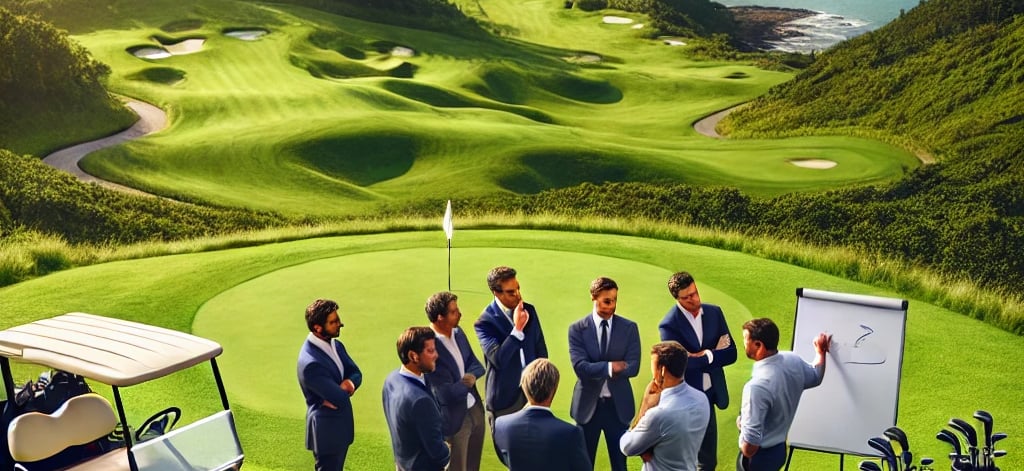

In an era where corporate gatherings are increasingly framed as opportunities to “live the brand” and embed purpose through experience, a pressing paradox emerges. On the one hand, the United States remains responsible for nearly 6,2 billion metric tons of greenhouse gas emissions (CO₂e) in 2023, with transportation alone accounting for about 30 % of total U.S. emissions. On the other hand, American businesses struggle to align culture, purpose and operational practices: the social cost of emissions generated by U.S. firms may total up to 87 trillion USD, surpassing some companies’ entire market value.
Meanwhile, at the heart of organisational performance and inclusion lies a significantly underserved workforce. It is estimated that around 10 % to 20 % of the U.S. population is neurodivergent (including conditions such as autism, ADHD, dyslexia), yet employment or under-employment rates among this group remain alarmingly high: for example, over 85 % of individuals with autism in the U.S. are unemployed. Moreover, a March 2024 survey found that 68 % of U.S. employees are unfamiliar with the term “neurodiversity”, and only 22 % say they have worked alongside a neurodivergent colleague.
These two realities — a heavy carbon footprint linked to corporate activity, and a large pool of human potential still marginalized in the workplace — present a unique invitation for companies to rethink their off-site seminars. Instead of defaulting to high-emission retreats or standard team-building programmes, forward-looking organisations might ask: how can we choose a destination that reflects both our environmental ambitions and our commitment to human inclusion? And how can the choice of location, format and partner activities become a strategic symbol of coherence between what we say we value and how we act?
Enter the Basque Country: a region where lush natural landscapes meet a tradition of craftsmanship, community and resilience. Here lies the potential for a business seminar that does more than “get away” — it becomes a signal of purpose, where team cohesion, golf, corporate-social responsibility (“CSR”) and inclusivity can converge in one rich experience. In the following paragraphs, we explore how such a seminar can serve not as a superficial offset but as a living metaphor of strategic alignment — between carbon awareness, neuro-inclusive human practice and meaningful corporate gathering.
Reuniting CSR and Management: From Good Intentions to Strategic Coherence
Organising an offsite seminar that brings together the CSR team and operational managers is not about changing the view — it’s about changing the conversation. Outside the company’s walls, hierarchies soften, and words flow more freely. In this neutral space, the discussions that rarely find time in board meetings — profitability, inclusion, carbon reduction, market competitiveness — can finally converge.
A seminar of this kind is not a reward trip; it’s an opportunity to align what a company believes in with what it delivers on the market. The goal is to explore, with transparency, how sustainability and inclusion can stop being perceived as “cost centres” and become instead real levers of growth and differentiation. When CSR and business teams work together rather than in parallel, a shared language of performance emerges.
Inclusion as a Driver of Performance
Neurodivergent professionals — including those with ADHD, autism or dyslexia — represent between 10 % and 20 % of the global population, yet remain one of the most underemployed groups in the workforce. In the United States, approximately 85 % of adults on the autism spectrum are unemployed or underemployed. Despite the rise of diversity policies, only 22 % of companies explicitly include neurodiversity in their inclusion strategy.
And yet, data shows that when neurodivergent talent is integrated with intention and adequate support, teams can be up to 30 % more productive. Large organisations such as Microsoft, SAP, and JPMorgan Chase have reported increased accuracy, creativity, and problem-solving abilities in departments that include neurodivergent employees. These results translate into measurable business performance — higher output, lower turnover, and improved innovation capacity.
A seminar that brings CSR leaders and managers together can be the setting where such realities are explored honestly. Imagine a workshop where a manager reflects on how to better harness the potential of an employee with ADHD — someone who excels in field sales thanks to creativity and empathy, but struggles in highly standardised telemarketing environments. When those conversations happen face-to-face, away from corporate filters, understanding deepens and solutions become actionable.
Rethinking Corporate Retreats: From Showmanship to Strategic Coherence
Forget the large-scale, high-emission corporate events that mimic the American “show” model. The future of meaningful leadership gatherings lies in smaller, high-impact teams who travel with purpose. A six-person offsite in the Basque Country is not just a seminar — it is a strategic retreat designed to realign a company’s CSR vision with both human and environmental realities.
A round-trip flight from New York to Biarritz via Paris emits roughly 2.6 tons of CO₂ per participant, which amounts to about 15.6 tons in total for six people. That’s still a footprint to be acknowledged, but nearly 88 percent lower than a traditional 50-person corporate event. And when every participant is carefully chosen — a mix of CSR leaders, key managers and external facilitators — each kilometre travelled serves a purpose. The trip becomes a space for genuine transformation rather than another item in a marketing calendar.
In the Basque Country, reflection naturally replaces performance. The landscapes invite silence, the pace of life slows down, and dialogue becomes possible again. Here, strategy is not discussed in PowerPoint mode but around a shared table — between the sea, the mountains and the authenticity of a culture rooted in respect for the land. This environment encourages teams to revisit fundamental questions: what does responsibility mean when measured against real human wellbeing? How can inclusion, far from being a financial cost, become a driver of performance and innovation?
By limiting the group to six people, a company moves away from symbolic actions and toward a true laboratory of coherence. Every discussion, every metric, every moment spent together can be connected to measurable outcomes: reducing internal carbon impact, improving employee engagement, or increasing retention among neurodivergent talents. In this way, the Basque retreat becomes not an escape from reality, but a return to it — where leadership, sustainability, and collective intelligence finally speak the same language.
Turning Conversations into Measurable Commitments
A seminar that unites CSR and management teams should never end with vague intentions. It should conclude with a framework of quantifiable commitments — realistic, traceable, and linked directly to business outcomes. A company that measures both its diversity metrics and sustainability data will soon realise that inclusion and performance are not opposites but interdependent forces.
Consider a neurodivergent data analyst with strong visual pattern recognition skills assigned to track the firm’s energy efficiency KPIs or carbon reduction models. Another employee who finds open-plan offices overstimulating could contribute remotely to life-cycle assessment or waste-management analysis. These examples illustrate how inclusion and sustainability reinforce each other through adaptability, accuracy, and creative thinking — the core drivers of competitiveness in the 21st century.
Yet, the real impact of a CSR-driven seminar only begins after the event — when commitments become communication, when strategy becomes narrative, and when the company learns to express its transformation in a way that resonates both internally and externally. Today, LinkedIn plays a decisive role in this shift. According to Edelman and Microsoft, 71% of B2B decision-makers trust CSR-related insights shared by employees more than messages published on corporate pages, and posts authored by collaborators generate up to 2.4× more engagement than brand-led communication. In other words, a seminar that is not followed by a clear, visible and multilingual communication strategy risks disappearing into silence.
This is even more crucial for organisations operating across borders. A sustainability message formulated in France under the lens of RSE must be adapted when communicated to English-speaking markets shaped by CSR, ESG and compliance frameworks. Meanwhile, Spanish-speaking markets prioritise community impact, transparency and local partnerships. Without multilingual coherence, the narrative fractures — and the company’s commitments lose visibility, influence and SEO authority.
Ultimately, the seminar becomes not only a space for reflection but a laboratory of coherence. When inclusion and sustainability are measured rather than moralised, when they are tracked through data rather than slogans, and when managers and CSR leaders learn to share a common strategic language — that is when the company begins to move from compliance to conviction, from marketing to meaning, and from symbolic action to measurable performance.
EUSKAL CONSEIL
9 rue Iguzki alde
64310 ST PEE SUR NIVELLE
07 82 50 57 66
euskalconseil@gmail.com
Mentions légales: Métiers du Conseil Hiscox HSXIN320063010
CGV & Mentions légales
Ce site utilise uniquement Plausible Analytics, un outil de mesure d’audience respectueux de la vie privée. Aucune donnée personnelle n’est collectée, aucun cookie n’est utilisé.