Navigate to Success: Why SMBs Benefit from Outsourcing Marketing Intelligence
Navigate to success by understanding how ADHD, dopamine, and neurodiversity reveal the real value of outsourcing marketing intelligence. Learn how small and midsize businesses can turn uncertainty into strategic resilience and sustainable growth.
MARKETINGVEILLE MARKETING
LYDIE GOYENETCHE
10/18/20253 min read

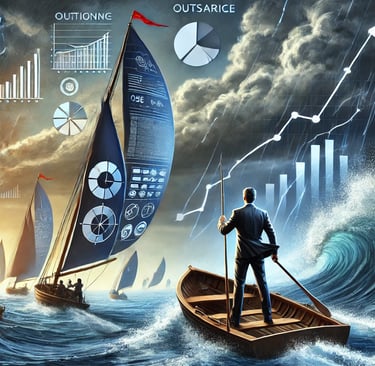
Turning Lack into Vision: ADHD, Dopamine, and Strategic Resilience
(How Neurodiversity Reveals the True Nature of Marketing Intelligence)
The Heart of Marketing: Turning a Problem into a Strategic Opportunity
At its core, marketing is not about communication or persuasion. It is about transformation. Every challenge, every constraint, and every limitation can become a source of strategic renewal. According to Deloitte’s 2023 Global Marketing Report, 62% of executives say that post-crisis behavioral shifts have forced them to completely redesign their marketing strategy. In other words, limitation has become the primary driver of innovation.
This is the essence of marketing: turning a problem into a strategic opportunity. And in this sense, the ADHD brain offers both a biological metaphor and a living model for adaptive intelligence.
The ADHD Brain: A Biology of Lack that Becomes a System of Adaptation
The ADHD brain operates with an irregular dopamine system. Dopamine, the neurotransmitter associated with anticipation, motivation, and reward, plays a crucial role in maintaining attention and executive control. Research published in Nature Reviews Neuroscience (Volkow et al., 2022) shows that people with ADHD have between 20% and 25% less dopamine availability in key areas of the prefrontal cortex.
This irregularity makes sustained attention and planning more difficult. But it also stimulates alternative pathways of thought. The ADHD brain compensates by forming fast associative connections, by embracing uncertainty rather than resisting it, and by improvising when structure fails. It becomes a living example of cognitive plasticity — of how the lack of dopamine becomes a source of creativity, not paralysis.
The Adaptive Enterprise: From Cognitive Biology to Strategic Behavior
The same dynamics that help the ADHD brain survive instability can be seen in resilient organizations. McKinsey’s 2024 study on “Agility and Market Intelligence” found that companies that continuously adapt their strategies in real time — instead of relying on fixed annual plans — achieve 30% higher growth over three years.
Like a neurodiverse brain, these organizations maintain a form of collective attention. They scan their environment, sense change, interpret signals, and act. Market uncertainty becomes not a threat but a stimulant — a form of organizational dopamine that fuels curiosity, experimentation, and innovation.
Marketing Monitoring as Organizational Dopamine
In the human brain, dopamine rewards learning and motivates further exploration. In a company, marketing monitoring plays a similar role. It provides information, feedback, and anticipation — the nutrients of strategic awareness.
According to Forrester’s 2023 Competitive Intelligence Benchmark, firms that invest consistently in market monitoring reduce their time-to-market by 23% and increase customer retention by 18%. These numbers reflect a simple truth: information stimulates motivation. Each new insight is like a small burst of organizational dopamine — an impulse that reawakens direction, purpose, and engagement.
When companies stop observing their environment, they lose that energy. Strategy becomes mechanical. Creativity fades. But when they maintain a living system of monitoring, they rediscover the flow of meaning — the same way the ADHD brain regains focus when reconnected to what stimulates it.
This is precisely why some organizations choose to be supported in structuring their marketing intelligence — not to control uncertainty, but to turn weak signals into strategic clarity.
From Handicap to Strategy: The Power of Cognitive Resilience
For the ADHD brain, resilience is not a skill to acquire — it is a daily condition of survival. Each day, it must rebuild its attention, find new ways to start, to focus, to stay. What seems to be instability becomes a practice of constant renewal.
This is what strategic resilience truly is. Harvard Business Review (2022) observed that 68% of the world’s most innovative companies have experienced at least one major crisis in the last five years. What distinguishes them is not stability but the ability to transform adversity into a catalyst.
The ADHD brain models this same behavior. It creates new mental routes when the usual ones fail. It transforms dysfunction into discovery. It mirrors what every modern organization must do in an economy of turbulence: evolve, reconfigure, and keep learning.
Neurodiversity as a Strategic Asset
More and more companies are beginning to recognize that neurodiversity is not a challenge to manage but a strategic advantage. Deloitte Global (2024) reports that organizations integrating neurodiverse talent — including individuals with ADHD, autism, or dyslexia — see an average 20% increase in productivity in R&D and innovation departments.
Neurodiverse individuals perceive the world differently. They are sensitive to weak signals, tolerate ambiguity, and make intuitive connections that conventional thinkers might miss. Their way of adapting to cognitive imbalance becomes a lesson in organizational intelligence. It is the same process the best marketing teams follow: transforming dissonance into direction, turning information overload into meaningful foresight.
Feeding Dopamine, Feeding Strategy
Marketing is, at its essence, the study of adaptation. It mirrors the same neural process that keeps the ADHD brain alive: transforming lack into movement, and movement into meaning.
The ADHD brain teaches us that intelligence is not born from control, but from relationship — the relationship to what is missing, uncertain, or fragile. Likewise, strategic intelligence grows not from rigid plans but from a company’s ability to feel, interpret, and act within complexity.
The most powerful organizations, like the most adaptive minds, do not fear the lack of certainty. They listen to it. They learn from it. They transform it into strategy.
Because in the end, both in the human brain and in the marketplace, the true heart of marketing is the same: turning a problem into a strategic opportunity.
EUSKAL CONSEIL
9 rue Iguzki alde
64310 ST PEE SUR NIVELLE
07 82 50 57 66
euskalconseil@gmail.com
Mentions légales: Métiers du Conseil Hiscox HSXIN320063010
Ce site utilise uniquement Plausible Analytics, un outil de mesure d’audience respectueux de la vie privée. Aucune donnée personnelle n’est collectée, aucun cookie n’est utilisé.