How to communicate effectively with your team – lessons from neuroscience and leadership
Discover the keys to effective managerial communication through neuroscience and social sciences. Managers adopt practices that captivate your teams and increase their engagement
COMMUNICATIONMANAGEMENT
LYDIE GOYENETCHE
11/9/20254 min read
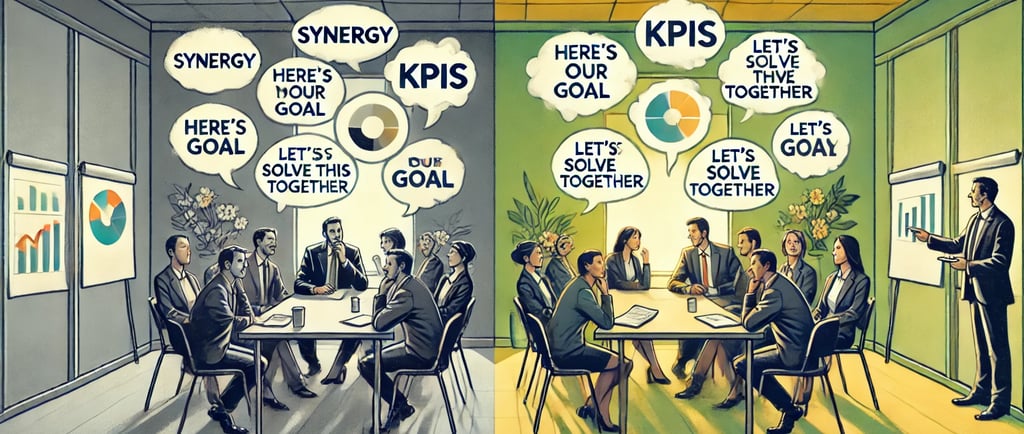
"Managers: Talk to your teams, not their reptilian brains!"
Communicating with your teams is a delicate art. According to a 2023 Gallup report, only 21% of employees worldwide feel truly engaged at work — a figure that often has less to do with motivation than with how messages are delivered by management. In other words, many leaders have great ideas, but they fail to make them resonate.
Whether in a startup or a multinational, communication shapes trust, clarity and collective performance. Yet too often, teams are talked at, not talked with.
To explore how to communicate better, let's take inspiration from big names — whether from neuroscience, social sciences, or popular culture. Because if Einstein, Darwin or even Netflix can teach us anything, it’s that clarity and emotion are the twin forces that captivate an audience — and ultimately, make a message stick.
Einstein was right: simplify, but not too much
Albert Einstein once said: “If you can't explain something simply, then you don't understand it enough.” Neuroscientists would agree — studies show that the human brain processes clear and concise information up to 400% faster than complex or ambiguous phrasing (Harvard Business Review, 2022).
The archaic brain, our oldest neurological layer, is wired to detect threats and conserve energy. When faced with overloaded sentences full of jargon — like “maximize cross-functional synergies” — it triggers cognitive fatigue rather than engagement. Research from the Journal of Business Communication indicates that employees retain only 10% of information from overly technical corporate briefings, compared to 60–70% when messages are short, concrete and emotionally framed.
Take a typical team meeting. Instead of saying, “We need to adopt a holistic, bottom-up strategy,” try something like: “Share your ideas — they’ll help us improve our approach.”
This simple rephrasing reduces mental load and increases comprehension and emotional engagement by more than 50%, according to a Stanford experiment on managerial communication.
In short, simplicity is not a sign of weakness — it’s a strategic advantage for anyone who leads humans, not robots.
"Darwin and the art of evolution: capture emotion to survive"
Charles Darwin taught us that it is not the strongest who survives, but the one who adapts. In the realm of communication, adaptation means knowing how to speak not only to reason but to the limbic system — the part of the brain that processes emotions, memories, and motivation.
According to neuroscientist Antonio Damasio, 95% of human decisions are influenced by emotion, not logic. When a message is purely rational, the brain filters it as “non-urgent” information. That’s why, in a corporate setting, stories increase memorization by up to 22 times compared to data alone (Stanford Graduate School of Business, 2020).
A 2023 study by Gallup also found that teams who feel emotionally connected to their company are 17% more productive and 21% more profitable than those who don’t. In other words, emotion isn’t decoration — it’s performance fuel.
So, imagine a meeting where, instead of reviewing a cold spreadsheet, you tell a concrete success story:
“Last year, thanks to your collective effort, we exceeded our target by 18%.”
That simple narrative activates dopamine and oxytocin, the “trust and motivation” chemicals that help people feel recognized. It transforms a sterile update into a shared victory, reinforcing both memory and morale.
"Netflix and the secret of a good plot"
Netflix knows how to captivate its audience: a clear plot, interesting characters, and a satisfying ending. Your meetings should follow the same principle. If they are poorly structured or too long, they risk losing your employees along the way.
A good meeting, like a good movie, should answer simple questions: what's the problem and what's the solution? For example, rather than endlessly discussing a vague strategy, present a specific agenda and concrete solutions. And remember: if you exceed 45 minutes, at least bring snacks, because no one listens on an empty stomach.
"Brené Brown and the power of vulnerability"
Brené Brown, an expert in vulnerability and leadership, reminds us that showing your imperfections can be a strength. There is no such thing as perfect managers, and your teams don't expect you to be infallible. Acknowledging your mistakes is proving that you are human, and it creates a climate of trust.
Imagine telling your team, "I made a mistake on this project, but here's what I learned and how we can avoid this in the future." This kind of honesty not only gives credibility to your leadership, but also inspires your employees to be more open about their own challenges.
"Aristotle and the balance of feedback"
Aristotle advocated moderation in all things. This also applies to feedback. Too critical, and you demotivate your teams. Too vague, and you miss the opportunity to help them progress. Finding the right balance means offering a balanced return that combines recognition and improvement.
Rather than saying, "Your report was bad," try, "Your report has some good ideas, but the presentation could be improved. How about working together to make it clearer?" This type of feedback mobilizes emotional memory and motivates your employees to give the best of themselves.
Conclusion: Communicate like a storyteller, not a robot
Communicating with your teams is like telling a good story: it requires clarity, emotion, and a solid structure. Draw inspiration from the lessons of Einstein, Darwin, Netflix, Brené Brown and Aristotle to transform your interactions. Talk less, listen more, and remember that your collaborators aren't there to decipher puzzles, but to work with you.
If you want your messages to resonate beyond meetings — whether with employees, partners or future clients — your digital presence needs the same clarity and emotional intelligence as your internal communication. LinkedIn has become the modern arena where leadership is evaluated long before a conversation begins. A well-crafted profile can amplify your voice, strengthen trust, and make your expertise unmistakable. If you’re ready to communicate with impact, not confusion, discover my dedicated support service: Managers: Talk to your teams, not their reptilian brains!
EUSKAL CONSEIL
9 rue Iguzki alde
64310 ST PEE SUR NIVELLE
07 82 50 57 66
euskalconseil@gmail.com
Mentions légales: Métiers du Conseil Hiscox HSXIN320063010
CGV & Mentions légales
Ce site utilise uniquement Plausible Analytics, un outil de mesure d’audience respectueux de la vie privée. Aucune donnée personnelle n’est collectée, aucun cookie n’est utilisé.